Actions
An action defines what LiveMock answers when an expectation matches. Three kinds of action exist:
| Action | Badge in the list | What it does |
|---|---|---|
| Custom response | RESPONSE | Returns a status code, headers and a body you write yourself. |
| Proxy | PROXY | Forwards the request to another host and returns its response. Also proxies WebSocket connections. |
| Static | STATIC | Serves files from a folder on the machine running LiveMock. |
Creating an action
In the Expectation detail view click Add action on the Action card (or the pencil, when the expectation already has one). The dialog has three tabs - Custom response, Proxy and Static - and applies the change when you click Save action. An expectation has exactly one action: switching the tab converts the existing action instead of adding a second one. An expectation without any action is skipped during matching, so remember to add one - an empty expectation matches nothing.
Custom response
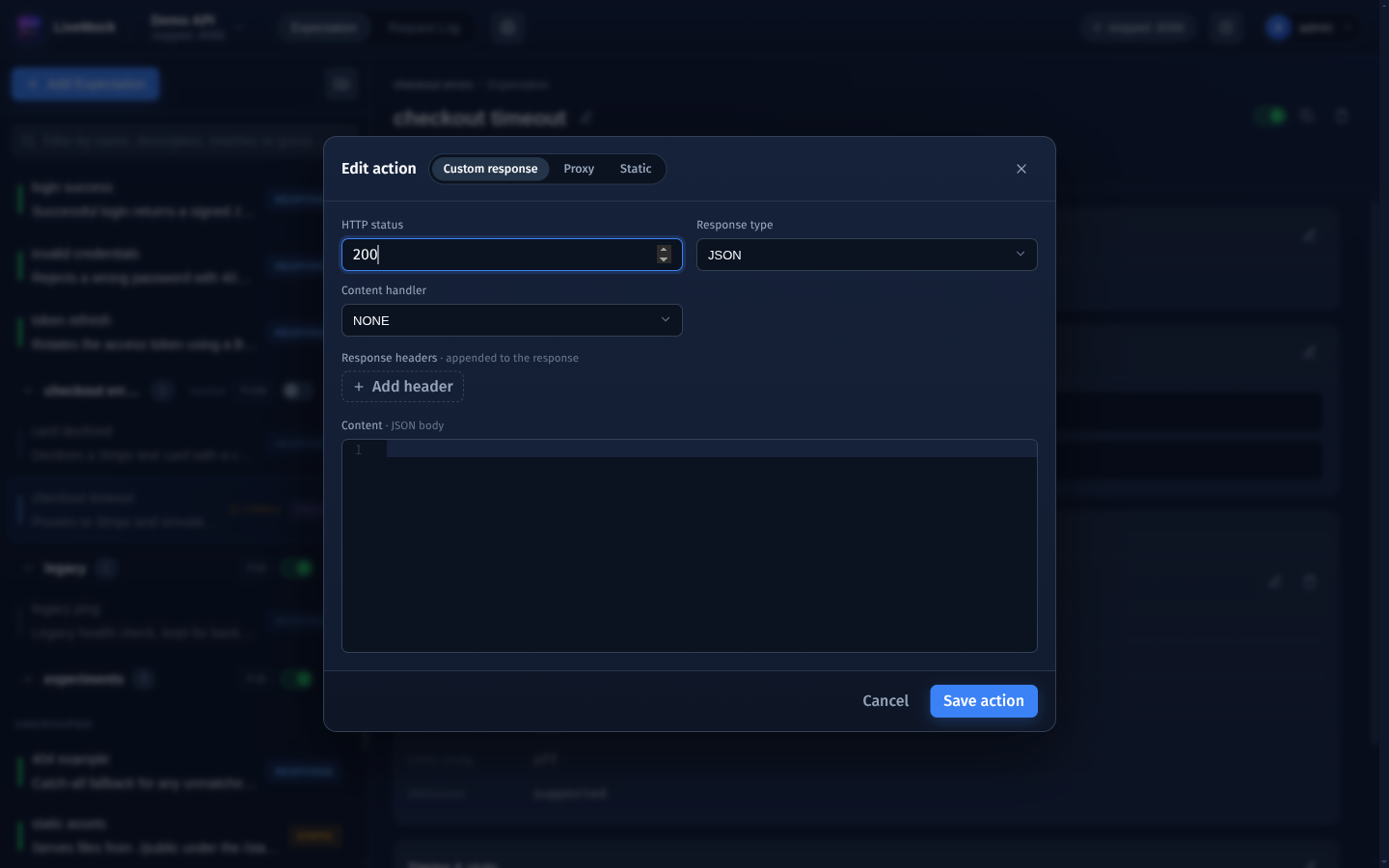
| Field | Meaning |
|---|---|
| HTTP status | The status code of the response, for example 200 or 404. |
| Response type | JSON or TEXT. It decides the Content-Type of the response. |
| Content handler | NONE returns the content as written; MOCKJS renders it with Mock.js templates. |
| Response headers | Extra headers appended to the response. |
| Content | The response body. |
Mock.js templates
With the content handler set to MOCKJS, the content is a Mock.js template and the
data is generated on every request:
{
  "id": "@id",
  "name": "@name",
  "email": "@email",
  "createdAt": "@datetime"
}
Proxy
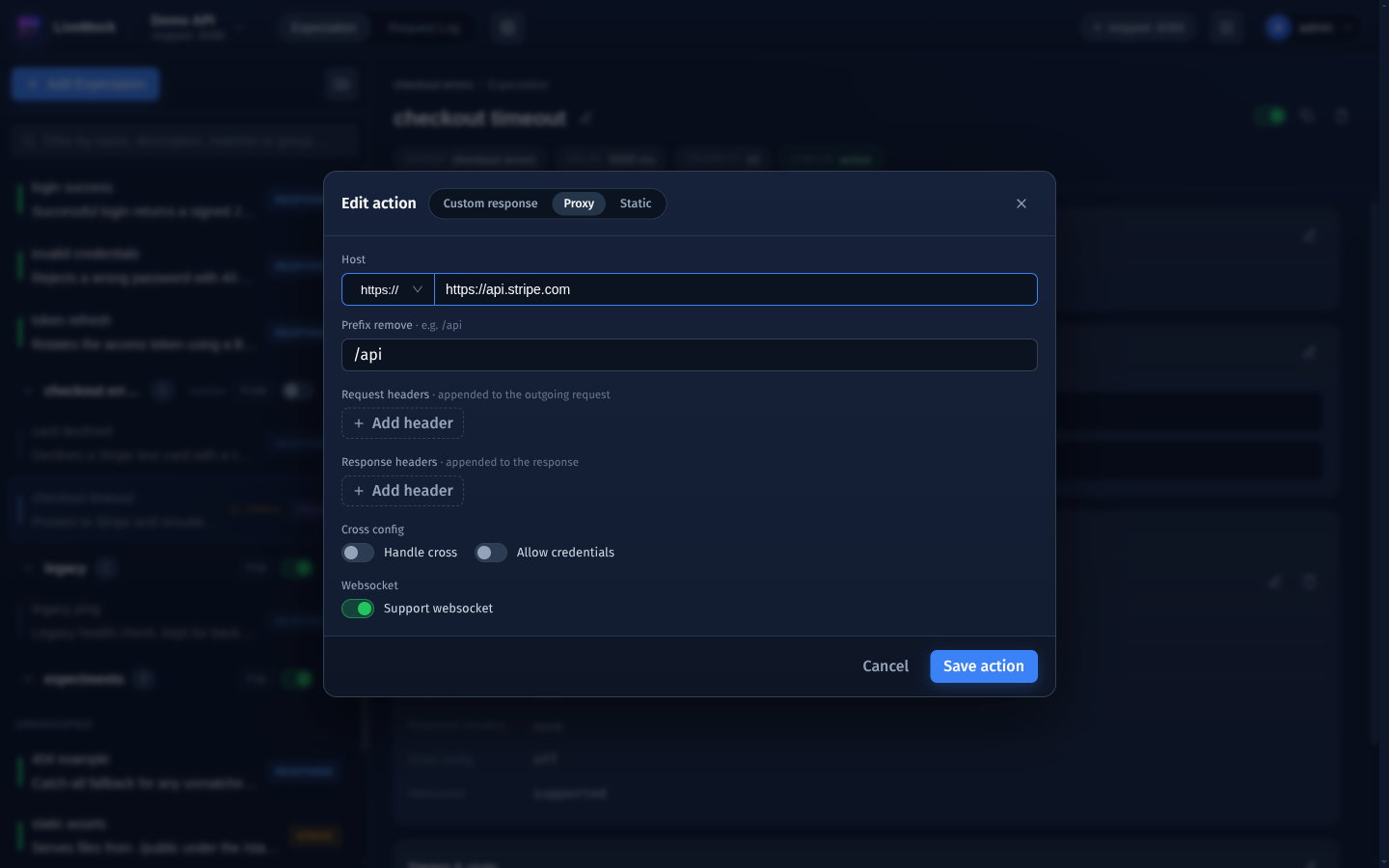
| Field | Meaning |
|---|---|
| Host | The target host, for example api.stripe.com. The protocol selector in front of the field chooses http:// or https://; pasting a full URL moves its scheme into that selector automatically. The host must not contain a path. The port always stays the default for the protocol (80 for http, 443 for https), and there is no separate field for a target port. |
| Prefix remove | A path prefix removed from the request before it is forwarded, for example /api: a request to /api/users is forwarded as /users. |
| Request headers | Headers appended to the outgoing request. |
| Response headers | Headers appended to the response before it is sent back. |
| Handle cross | Adds permissive CORS headers to the response. |
| Allow credentials | With Handle cross, sends Access-Control-Allow-Credentials: true so browser clients can send cookies. |
| Support websocket | Forwards Upgrade: websocket connections too. The messages exchanged are recorded in the request log. |
Static
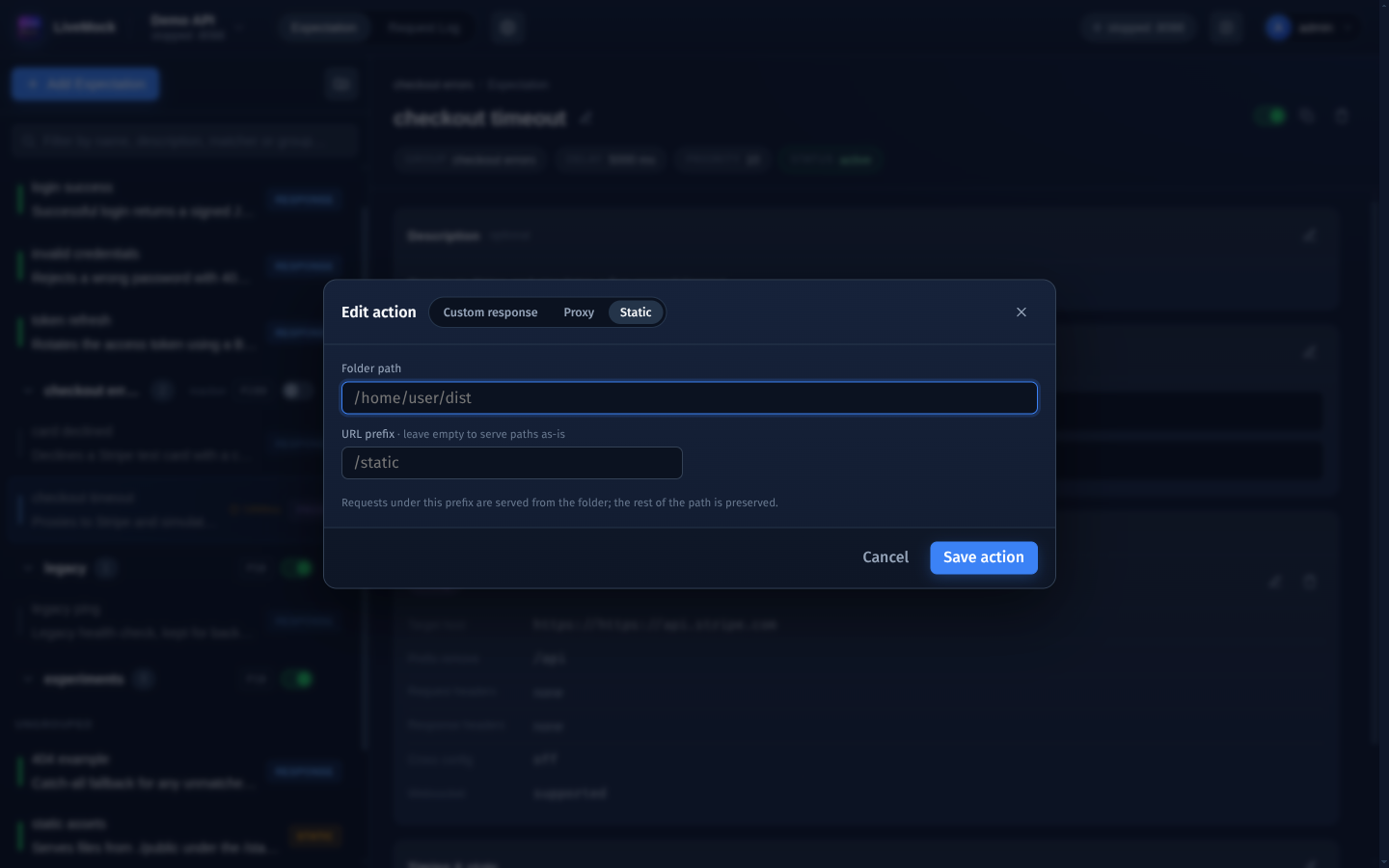
| Field | Meaning |
|---|---|
| Folder path | Absolute path of the folder on the machine running LiveMock, for example /home/user/mock-assets. Relative paths are resolved against the working directory of the server, which in Docker is /app. |
| URL prefix | Requests under this prefix are served from the folder; the rest of the path is used as the file path. Leave it empty to serve request paths as-is. |
For example, with folder /srv/assets and prefix /static, a request to /static/logo.svg returns
/srv/assets/logo.svg. A request outside the prefix, or a file that does not exist, gets a 404.
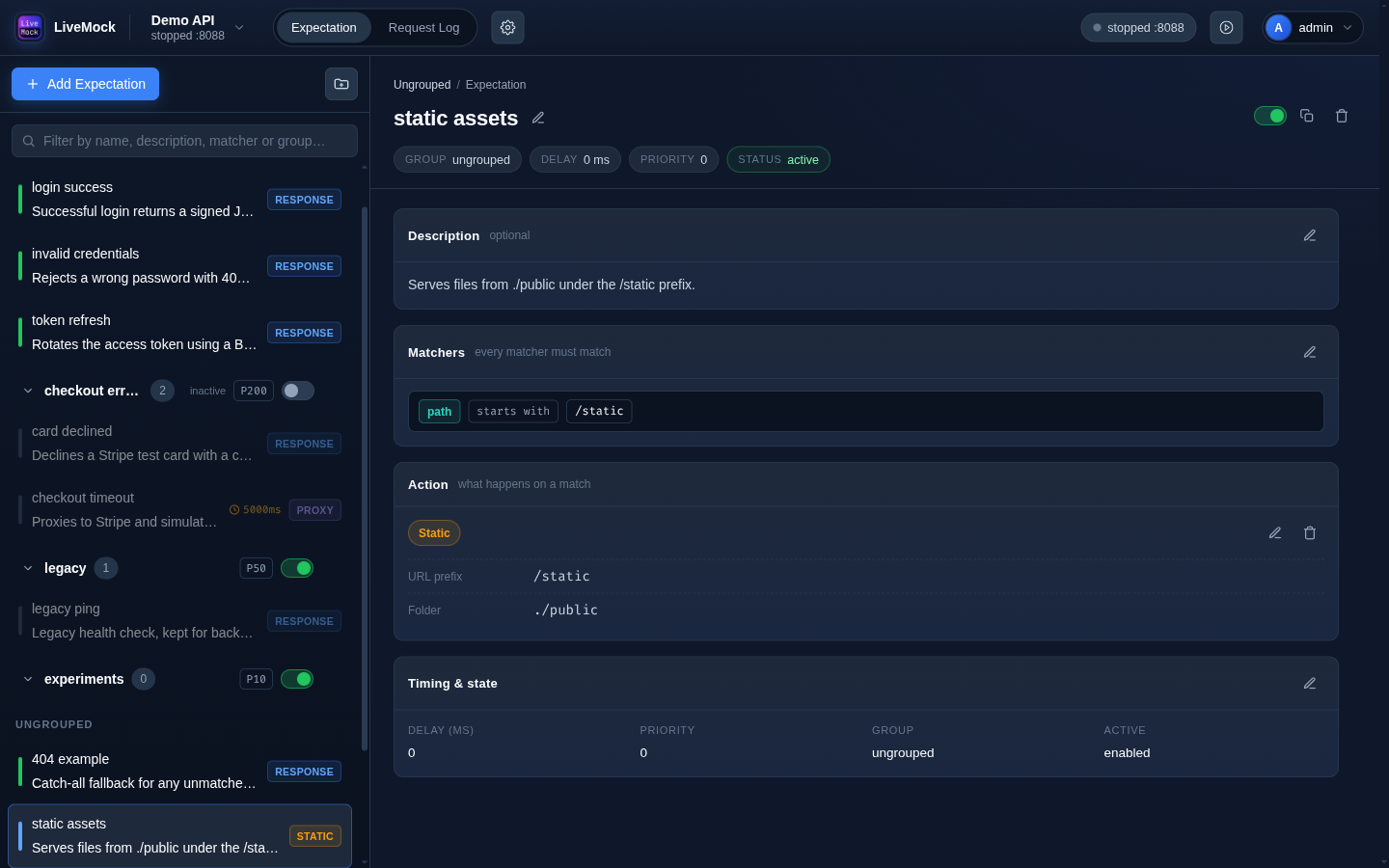
Delay
The delay is not part of the action: it is set on the expectation itself (Timing & state) and applies to every kind
of action. An expectation with a delay of 5000 waits five seconds before answering, which is handy to reproduce
timeouts in the client.
The proxy host does not have a port field: connections are made to the default port of the chosen protocol, which is why
a backend that listens on a custom port (for example localhost:3000) cannot be targeted directly. Put a reverse proxy
in front of such a backend, or point the host at a hostname that already resolves to the right service.